STRUGGLE AND STATE REPRESSION IN KENYA
Introduction: The University as a Site of Class Struggle
The history of student politics in Kenya cannot be understood separately from the history of class struggle in Kenyan society.
Since independence in 1963, Kenyan students have repeatedly confronted the state over political repression, economic inequality, imperialism, unemployment, education, democratic rights and the concentration of wealth and political power. these struggles are not isolated disturbances occurring within universities. They are manifestations of contradictions within a society structured by class relations.
Political independence transferred formal state power from British colonial authorities to African political elites, but it did not automatically dismantle the economic structures inherited from colonialism. Land ownership patterns, dependence on foreign capital, unequal development, the dominance of multinational corporations and the orientation of the economy toward international capital remained important features of postcolonial Kenya.
The Marxist-Leninist question is therefore not simply whether Kenya became politically independent. It is whether the working people acquired political and economic power over the conditions of their own existence.
It is within this contradiction that revolutionary student politics must be understood.
Students occupy a particular position in the class struggle. They are not themselves a homogeneous class. They come from different class backgrounds and will enter different positions within society. But universities can become important centres of ideological struggle because they bring together young people experiencing unemployment, inequality, rising education costs, poor housing, political exclusion and the contradictions of capitalist development.
The history of Kenya demonstrates that when students move from individual grievances toward collective political organization, they can become an important force in wider struggles for social transformation.
- Independence and the Preservation of Colonial Economic Relations
The achievement of independence in 1963 was an historic victory against British colonial rule. However, political independence did not amount to a complete transformation of the social and economic relations created under colonialism.
The post-independence state inherited the colonial administrative apparatus, security institutions, courts, prisons and economic structures. Rather than dismantling these institutions completely, the new ruling elite inherited and adapted them.
This distinction is crucial.
The colonial state had been constructed to suppress African resistance and protect colonial economic interests. After independence, many of its institutional mechanisms remained available to the postcolonial ruling class.
Consequently, the state could simultaneously present itself as the instrument of national independence while maintaining coercive institutions capable of suppressing popular movements.
Students would repeatedly encounter this contradiction.
- The University and the Development of Revolutionary Consciousness
During the 1960s, university students were generally less politically militant. However, the political character of student life changed significantly during the 1970s.
The expansion of higher education brought students from increasingly diverse social backgrounds into universities. At the same time, students were confronted with worsening economic conditions, limitations on democratic politics and the increasingly authoritarian character of the state.
The banning of the Kenya People’s Union in 1969 and the assassination of Tom Mboya contributed to growing political tensions. The assassination of J.M. Kariuki in 1975 became another major catalyst for student mobilization.
Academic research shows that the University of Nairobi increasingly became a centre of national dissent during the 1970s. The state consequently began treating politically active students as a security threat rather than simply as members of an academic community.
This development can be understood as an intensification of ideological struggle.
The ruling class requires not only control over economic resources but also ideological influence. Universities are therefore politically important because they can either reproduce the dominant ideology or become centres where that ideology is challenged.
- The State, Repression and the Bourgeois Character of Political
The state is not simply as a neutral institution standing above society.
The state contains competing institutions and contradictions, but its fundamental political and economic structures are connected to the existing relations of production.
This helps explain why governments that proclaim democratic principles can simultaneously deploy police, prisons, intelligence agencies and courts against organized political opposition.
Kenyan student history provides numerous examples.
During the 1970s and 1980s, student organizations were banned, student leaders detained, universities closed and left-wing lecturers targeted. Research on the period documents the banning of the Nairobi University Student Organization, the deregistration of the academic staff union and detention of student leaders and leftist lecturers under the Moi regime.
The question therefore becomes:
Why does the state become so concerned when students begin transforming their grievances into organized political consciousness?
The answer lies partly in the difference between spontaneous protest and organized political struggle.
A student demanding better food may challenge an administrator.
A student movement connecting food prices, unemployment, privatization, capitalist exploitation, imperialism and state policy begins challenging the broader social relations that produce those conditions.
The latter has a fundamentally different political character.
- The Moi Dictatorship and the Attempt to Produce an Obedient Student
The authoritarian period under Daniel arap Moi provides perhaps the clearest historical example of the state’s attempt to control student consciousness.
Following the 1982 attempted coup, the Moi government intensified repression at the University of Nairobi. The university became one of the major centres of political dissent targeted by the state.
In 1984, the government introduced the National Youth Service Pre-University Training Programme.
The objective was explicitly political as well as disciplinary. Research shows that the programme was intended to instil discipline and loyalty to the Moi regime among prospective university students.
But history produced an important contradiction.
The attempt to manufacture obedient students contributed to producing more politically conscious students.
The programme exposed thousands of young people to state discipline and coercive authority. Instead of permanently suppressing political consciousness, these experiences helped some students develop solidarity and opposition to the government. Research describes the programme as having helped radicalize a vocal group of students who later confronted the Moi state.
This demonstrates an important Marxist proposition:
Contradictions cannot simply be eliminated through coercion.
Attempts to suppress a contradiction can sometimes deepen it.
- “Bloody Sunday” and the Violent Defence of State Power
The confrontation reached a particularly brutal point on 10 February 1985.
Following disputes concerning expelled students and withdrawn scholarships, students organized a prayer meeting at the University of Nairobi. Security forces intervened. According to historical research, 65 students and 32 police officers were injured and University of Nairobi student Jacob Okhalo Wandera was killed.
The incident became known as
Bloody Sunday
The significance of the event extends beyond the immediate confrontation.
Students were asserting their autonomy and challenging the state’s authority over university political life. The state’s response demonstrated the willingness of security institutions to intervene forcefully when student organization became politically threatening.
Later in 1987, after newly elected student leaders adopted positions calling for greater student participation in national political debates and challenging government patronage, security forces arrested prominent student leaders. The university was subsequently closed and dozens of students were expelled.
The university therefore became a miniature battlefield in the wider political struggle over Kenya’s future.
- Student Struggle and the Second Liberation
The 1980s produced a generation of students who increasingly connected campus struggles with the broader struggle against authoritarian rule.
The struggle for multiparty democracy eventually brought together students, workers, intellectuals, lawyers, religious organizations and opposition movements.
This period demonstrates both the possibilities and limitations of liberal democratic reform.
The restoration of multiparty politics expanded political freedoms. However, political pluralism did not automatically abolish capitalist exploitation, class inequality or dependence on international capital.
The political form of the state changed, but many of the underlying economic relations remained.
Consequently, revolutionary student politics cannot end with the demand for elections alone.
The question must proceed further:
Who owns the productive forces? Who controls land, finance and industry? Who benefits from economic growth? Who bears the cost of unemployment, taxation and austerity?
These are fundamentally questions of political economy.
- From Political Patronage to Neoliberalism
The post-Moi period introduced new contradictions.
Student organizations gained greater formal political space, but campus politics increasingly became influenced by national political parties, patronage networks and ethnic political competition.
This presents another mechanism through which ruling-class politics can penetrate student organization.
Instead of suppressing every student organization outright, political elites can attempt to incorporate student leaders into existing systems of patronage.
This produces a distinction between independent student organization and student politics subordinated to bourgeois electoral competition.
At the same time, neoliberal economic policies transformed the material conditions facing students and workers.
Privatization, commercialization, structural adjustment, unemployment and the increasing cost of education placed greater pressure on working-class and poor students.
The university increasingly became connected to the reproduction of a labour force for a capitalist economy while students themselves faced uncertainty about whether that economy could provide them with meaningful employment after graduation.
This contradiction remains central to contemporary student politics.
- The 2024 Generation and the Birth of the Revolutionary Students Commission
The year 2024 marked an important political turning point among Kenyan youth.
The Finance Bill protests demonstrated the capacity of young people to challenge state policy outside traditional political-party structures.
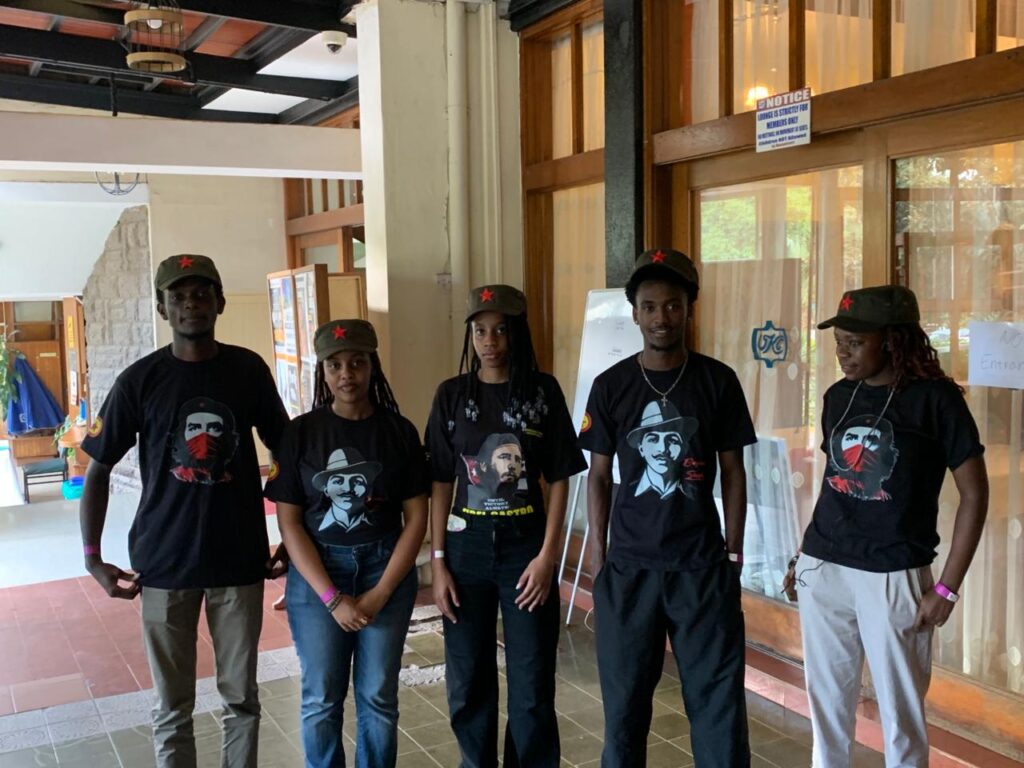
It was within this broader political environment that the Revolutionary Students Commission (RSC) emerged in November 2024.
The RSC represents an explicitly Marxist-Leninist tendency within Kenyan student politics.
Its political intervention seeks to move student activism beyond periodic demonstrations and electoral competition toward organization, political education and the development of class consciousness.
Its fundamental argument is that students cannot permanently resolve their problems through isolated campus reforms while the wider economic system continues to produce unemployment, poverty, inequality and exclusion.
Consequently, the RSC has sought to connect student struggles with the struggles of workers and other oppressed sections of society.
Its approach emphasizes several interconnected tasks:
- political education;
- organizing students around their material conditions;
- connecting campus struggles with broader working-class struggles;
- opposition to imperialism and neo-colonial domination;
- building independent student organization;
- challenging the commercialization and commodification of education;
- developing revolutionary consciousness; and
- creating a politically organized student movement rather than a purely electoral student structure.
In Leninist terms, this raises the question of organization.
Spontaneous anger can produce protest, but revolutionary politics requires organization capable of transforming spontaneous resistance into conscious political struggle.
The historical experience of Kenya demonstrates that repression can suppress individual demonstrations. It is much more difficult to permanently eliminate political consciousness once it becomes organized and reproduced through political education.
- The Africa Forward Summit and the Arrest of Five RSC Cadres
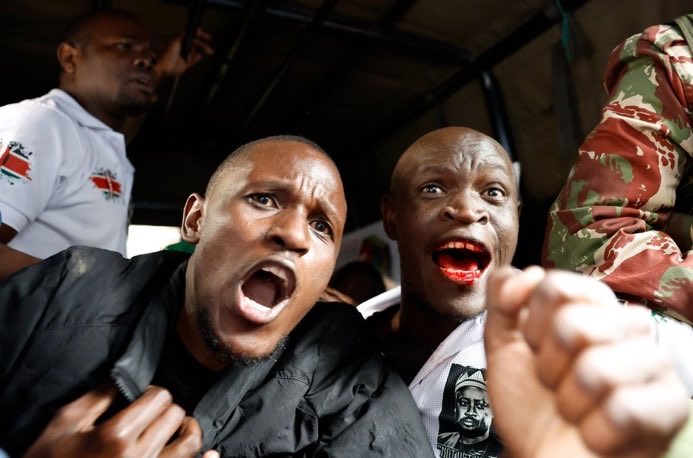
The conflict between revolutionary student organization and state authority became particularly visible in May 2026 during protests surrounding the Africa Forward Summit in Nairobi.
According to reporting, five students associated with the Revolutionary Students Commission were arrested on 11 May during protests against the summit. They were identified as Beres Muthombi, Tracy Auma, Patience Nyambura, Jobunga Samuel and Kenneth Juma. The arrests were reported in connection with allegations of unlawful assembly.
Other protesters were also arrested during demonstrations surrounding the summit. Kenyan media reported that police blocked protesters and that several people were detained.
The arrests represented repression of anti-imperialist student organizing.
The organization’s political interpretation places the Africa Forward Summit within the broader question of French and Western imperial influence in Africa and the continuing dependence of African economies upon international capital.
- Imperialism and the Kenyan Student Question
Imperialism is not simply a question of foreign military intervention.
It also concerns the international concentration of capital, unequal economic relations, control of strategic resources, debt, trade relationships and the political influence of powerful states and multinational corporations.
This makes the African university an important ideological battlefield.
Students are educated to participate in economies whose structures are often shaped by international capital and institutions. Yet those same students can become conscious of the contradictions between the wealth generated by African labour and the persistent poverty experienced by African populations.
The revolutionary student therefore asks:
Why does a continent possessing immense natural and human resources continue to experience mass unemployment, poverty and economic dependency?
A Marxist answer locates the problem not primarily in individual corruption or incompetent leadership but in the structure of the political economy.
This does not mean denying the role of individual political decisions. Rather, it means placing those decisions within the broader relations of production and international capitalism.
- The Student as an Ally of the Working Class
Marxism-Leninism does not regard students as a substitute for the working class.
Students are a heterogeneous social group.
Some will become employers, managers, professionals and state officials. Others will become workers, unemployed graduates or precarious labourers.
Therefore, revolutionary student politics must avoid treating “students” as a permanent revolutionary class.
The strategic task is instead to connect politically conscious students with the broader working-class and popular struggle.
The university should become a site for political education, not a political island.
The revolutionary student movement must therefore ask:
How does the struggle for affordable education connect to the struggle against precarious employment?
How does the struggle against university privatization connect to the struggle against privatization of public services?
How does student unemployment connect to the exploitation of workers?
How does foreign corporate ownership connect to Kenya’s economic dependence?
How does police repression of students connect to the broader coercive apparatus used against workers and popular movements?
These connections transform isolated grievances into questions of class politics.
- Repression Cannot Resolve the Contradictions
The history of Kenyan student activism demonstrates an important contradiction in the state’s approach to dissent.
Governments have repeatedly attempted to suppress student movements.
Universities have been closed.
Organizations have been banned.
Students have been arrested.
Student leaders have been expelled.
Security forces have intervened on campuses.
Yet student resistance has repeatedly re-emerged.
The historical evidence concerning the Moi period is particularly instructive. The government attempted to use the National Youth Service Pre-University Training Programme to produce obedient students, but research demonstrates that the programme unexpectedly contributed to the radicalization of some of those students.
This illustrates a central principle of dialectical materialism:
Contradictions are the driving force of development.
Repression may temporarily suppress a movement, but it does not automatically eliminate the material conditions generating resistance.
As long as unemployment, inequality, political exclusion, economic dependency and social injustice persist, new generations will continue to confront these contradictions.
–14. The Revolutionary Task
The revolutionary task of students is therefore not simply to produce louder protests.
It is to build organization.
It is to study.
It is to develop political consciousness.
It is to understand the relationship between economic structures and political power.
It is to reject ethnic chauvinism and understand the material interests that divide working people.
It is to challenge imperialism while avoiding empty nationalism.
It is to connect campus struggles with workers’ struggles.
It is to build democratic and accountable student organizations.
It is to develop cadres capable of political education and mass organizing.
And above all, it is to understand that revolutionary politics cannot be reduced to slogans.
A revolutionary organization must demonstrate through practice that another political culture is possible: collective decision-making, accountability, political education, solidarity and organization around the material needs of ordinary people.
Conclusion: From Student Resistance to Revolutionary Organization
From the demonstrations of the 1970s to the militant student movements of the 1980s, from the struggle for multiparty democracy to the youth mobilizations of 2024, and from the formation of the Revolutionary Students Commission in November 2024 to the arrest of five RSC cadres during the May 2026 Africa Forward Summit protests, Kenyan student politics has repeatedly intersected with the country’s wider political struggles.
The history demonstrates that the university is not politically neutral.
It is a site where competing ideas about society, economics and political power confront one another.
For Marxist-Leninist students, the objective cannot be merely to replace one group of student leaders with another or to win isolated campus elections.
The strategic question is larger:
Can students develop the political consciousness and organization necessary to connect their immediate struggles with the broader struggle of workers and oppressed people for social and economic transformation?
The answer will not be determined by slogans alone.
It will be determined through organization, political education, mass work and sustained engagement with the material conditions of the people.
The revolutionary student must therefore move beyond the politics of complaint toward the politics of organization.
Beyond spontaneous anger toward conscious struggle.
Beyond individual ambition toward collective emancipation.
And beyond the university campus toward the wider struggle for a society in which political and economic power is placed in the hands of the working people.
The history of Kenyan student resistance demonstrates that repression has never permanently extinguished political consciousness.
The task of the present generation is to transform that consciousness into organized political action and to connect the struggles of students with the broader struggle against exploitation, imperialism and neo-colonial domination.